|

|
 |
 |
|
|
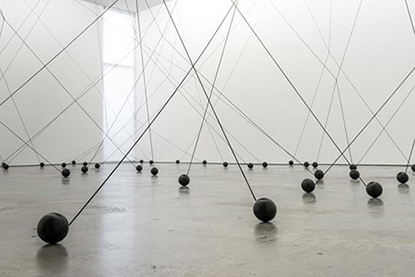
Magdalena Fernández, "2i000.017," 2017, iron spheres with black elastic cord, dimensions variable. Photo: Peter Molick
|
|
 |
|
|
|
|
|
Magdalena Fernández
Sicardi Gallery, Houston, Texas
by Donna Tennant
|
|
|
Continuing through March 11, 2017
|
|
|
Venezuelan artist Magdalena Fernández is best known for her monumental sculptural and video installations. The drawings and sculptures in this show, as well as small videos, are impressive. "Flexible Structures" is something of a mini-retrospective, with drawings dating back to 1999 and videos from 2004-2005. The sculptures, however, are all from 2016, and the large installation in the downstairs gallery was designed specifically for the space. Titled "2i000.17," black steel spheres on the floor are connected by black elastic cords crisscrossing the space. It is designed to be interactive, in that visitors must step around and over the cords to enter the space, where they are encouraged to touch them. Overall, it functions as a huge drawing… READ MORE |
|
|
Editors' Roundtable
by Matthew Kangas
The death of emeritus professor of art Francis Celentano (1928-2016) brings to an end a long pedigree of the University of Washington School of Art, its close links to European artists and art schools birthing modern art in the past century. Celentano's 1958 Fulbright year in Rome changed his life after his encounters with hard-edge painter Piero Dorazio and other members of the burgeoning optical perceptual painting movement. Not only one of the first scholars of abstract expressionism, Celentano studied painting privately with Philip Guston for a decade and was acquainted with all the members of the New York School at the Cedar Bar. These encounters led to the first graduate thesis on Abstract Expressionism, Celentano's "Origins and Development of Abstract Expressionism in the United States" (M.A., 1957) written under H. W. Janson and cited by Harold Rosenberg in his monograph, "De Kooning" (1973), among many others.
We will never know what else happened in Rome that year, but when the 30-year-old art historian and nascent abstract expressionist returned to Manhattan, his rejection of the New York School was complete and utter. He remained hilariously contemptuous of the movement for the rest of his life in conversation and in print. For example, his 1991 unpublished eulogy for Robert Motherwell was really an attack on the older artist (who was born in Aberdeen, Wash.) and his cohorts. Celentano's re-definition of Abstract Expressionism was priceless: It was "a disturbing environmental and painterly oil pollution that spread throughout the leading industrial countries." He accused Motherwell of "soft mental ooze," guilty of a type of painting "which puddles lines and drips oil blithely enhancing the adult myth of a child-like ideal for expulsive permissiveness." In other words, such painting was akin to a baby defecating.
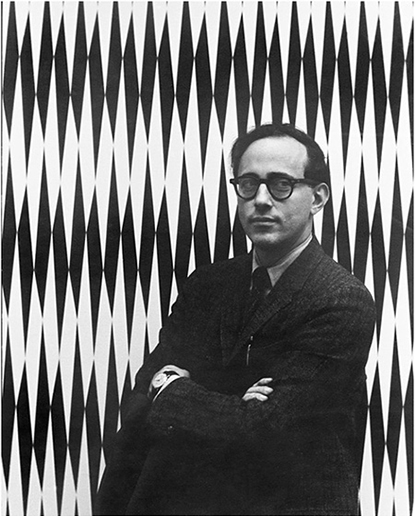
Hired by UW School of Art director Spencer Moseley (who had done postgraduate work in Paris with Léger), Celentano warmed to Moseley's bent for color theory, chiefly that of M. E. Chevreul, a 19th-century theorist who held that the juxtaposition of two complementary tones heightened their intensity and that chromatic properties change when set next to black. Upon arriving in Seattle in 1966, the Bronx-born Italian-American unleashed a fast-moving train of work that remained on track for 50 years, until his death last year at 88. The huge black-and-white "Reversible Units" (1966), perhaps his greatest work, answered Bridget Riley's feminine curves with rigid, monumental, interlocking, stiletto-dagger stripes that were more masculine and assertive than Riley's lacework.
Thanks to the example of two graduate students experimenting with automotive spray paint, Celentano followed suit and never picked up another brush. The results were methodically colorful, like Chevreul or Josef Albers. The cerebral and systemic permanently replaced the subjective and open-ended, unfinished look. The total opposite of the New Yorkers in that sense, each picture's outcome was determined ahead of time, working backwards so to speak, with tall thin sprayed strips of PVC plastic, cut up and glued back together, then switched end to end.
These were not the paintings to which New York had paid attention when he was younger. Those works, such as "Lavender Creed" and "January 20, 1964" (both 1964) were pre-Op, more hard-edge, with the latter appearing in "The Responsive Eye," the Museum of Modern Art, New York, exhibition that birthed the Op Art movement. It wasn't until decades later that his involvement with Howard Wise Gallery and his inclusion in the pivotal "International Artists Seminar" at Fairleigh Dickinson University in 1965 were acknowledged. Columbus Museum of Art curator Joe Houston borrowed "Phalanx" (1965) and "Kinetic Painting III" (1967) for his "Optic Nerve: Perceptual Art of the 1960s" in 2007.
Over the years, working uninterruptedly, Celentano explored canvas shape, added electric motors, branched out to sculpture with colored, tall cylinders, and completed a 42-foot wide mural for Seattle-Tacoma International Airport in 1972, "Spectrum Delta II."
In another dialectical turnabout, some of the paintings satirized the gigantism of AbEx, shrinking to 24 inches wide yet 12 feet high. Building on mathematical structures aligned to alternating repetitive systems, Celentano's demonic productivity accumulated to extravagant proportions, eventually displayed at two retrospectives, one at the Whatcom Museum in Bellingham, Washington in 1994, the other at Hallie Ford Museum of Art in Salem, Ore., in 2010.
Despite occasional critics who thought the work exhausted or trivial ("optical trickery," as Ron Glowen put it in Artweek), Celentano was revered by other critics and students. According to Prix de Rome fellow and colleague Michael Spafford, "Students told me he gave them the most brilliant descriptions of color of any teacher they had … Once, when we went to New York, he let us use his loft and we saw tons of his Abstract Expressionist paintings in the racks."
Eventually, the New York gestural works were removed to Seattle and carefully stored — but never exhibited. Celentano would appear wounded or offended when critics or curators inquired after them. Sadly, chief interest today in New York is for these works, possibly because of their connection and similarity to his mentor Guston.
However, Pacific Northwest art museums, galleries, collectors and critics loved the later Op art works. After all, Celentano was like a rare, formerly extinct species: an Op artist who didn't realize the movement was dead, buried, vilified and ridiculed for its decorative superficiality. The transplanted New Yorker survived all the dismissals, attacks and neglect. Adapting easily to computers, he intensified the complexity of his compositions even more, as in the "Electra" (1990-92) series. Returning to the big wide AbEx rectangular format, the artist in his 80s filled expanses of canvas with rows of tiny repeated shapes against a cool blue background.
Favoring the land of fellow color-scientist Chevreul more than the precincts of New York or Seattle, Celentano's final years involved extended stays in Paris, affirming his international roots and temporarily exiling himself from the American cities where he had flourished, foundered, and quietly triumphed in the privacy of an immaculately clean studio.
[The Editor's Roundtable is a column of commentary by our own editors and guest columnists from around the region. Their opinions do not necessarily reflect that of Visual Art Source or its affiliates.]
|
|
|
 |
|
Francis Celentano with "Reverse Units," 1966, 72 x 44"
See Matthew Kangas's column, left
|
|
|
|
 |
|
|
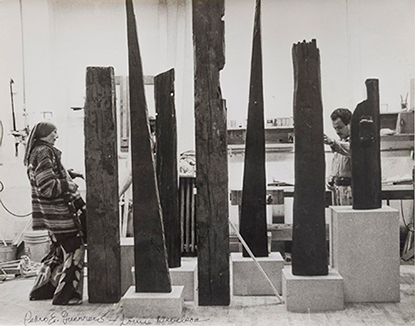
Pedro E. Guerrero, "Louise Nevelson with Salvaged Wood Sculpture," 1978, silver gelatin print, 11 x 14"
|
|
|
Pedro E. Guerrero
Edward Cella Art + Architecture, Culver City, California
by Scarlet Cheng
|
|
|
Continuing through March 4, 2017
|
|
|
Pedro E. Guerrero was a photographer who is now being rediscovered, especially after the documentary "Pedro E. Guerrero: A Photographer's Journey" was aired on PBS a couple years ago. In 1939 when he was 22, he found his life's calling when hired by Frank Lloyd Wright to shoot the construction of Taliesin West. Wright so liked the results that he invited the young man to join his Fellowship, and Guerrero documented the architect's work for the next two decades. By the 1950s he was much in demand as an architectural photographer, at a time when architects like Eero Saarinen and Phillip Johnson were becoming stars. Later he also became known for documenting the life and work of two major American artists, Alexander Calder and Louise Nevelson. This show concentrates on about two-dozen of these Calder and Nevelso… READ MORE |
|
 |
|
|
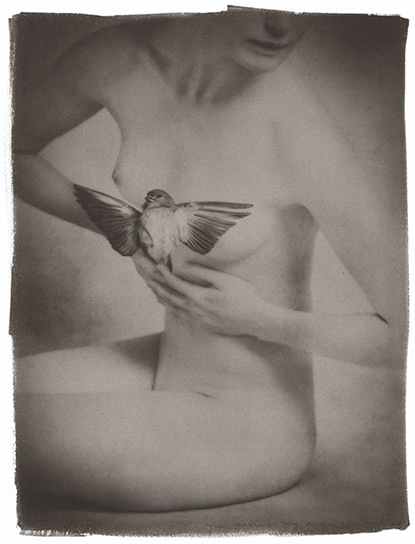
Brigitte Carnochan, "Like Birds in a Cage," 2015, platinum palladium photograph, 11 x 14". Courtesy of Themes+Projects"
|
|
|
Brigitte Carnochan
Themes + Projects, San Francisco, California
by DeWitt Cheng
|
|
|
Continuing through February 25, 2017
|
|
|
In New York in 1929 George Daniels, a young bank executive, met Edna MacInnis, a nursing student, beginning a three-year courtship, much of it conducted through daily correspondence. A trove of seventy-three of his letters, written on Bank of Canada stationery from George's employer, somehow found its way onto eBay, from which it was acquired almost accidentally by photographer Brigitte Carnochan. She realized its value only years later, while cleaning her studio: "In this series I use photos of my imagined Ednas to respond to excerpts from the letters that I believe she might have singled out … What would the writer of the letter[s] think, could he see 'them' on display in such a way? … I hope he would be pleased to see his narratives of daily life, his dreams… READ MORE |
|
 |
|
|
“En Face”
Aspect Ratio, Chicago, Illinois
by Robin Dluzen
|
|
|
Continuing through February 25, 2017
|
|
|
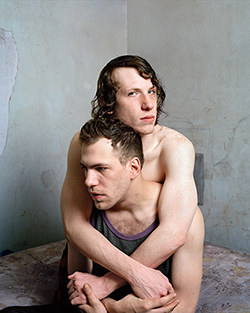
"En Face" features figurative works — by Glen Fogel, Lisa Lindvay, Martin Murphy, Laís Pontes, and Michal Samama — that reference the "portrait," though they reveal more about the nature of people and the spaces we inhabit than the individual person depicted. In a selection from Fogel's series, "Call me and we can buy love together," images of defaced movie posters are like glimpses into the psyches of unknown vandals. Pontes' "Self and Other" and Murphy's "Today's Face" both negate their subjects. The mirror substrate in the former distracts us… READ MORE |
|
|
Left: Lisa Lindvay, "Ryan and Nick in their Bedroom," 2016, archival inkjet print, edition of 5 & 2 APs, 40" x 32"
|
|
 |
|
|
Lisa Cardenas
Carneal Simmons Contemporary, Dallas, Texas
by John Zotos
|
|
|
Continuing through February 11, 2017
|
|
|
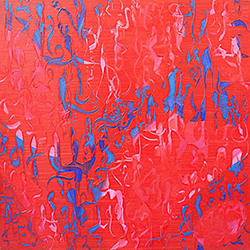
A suite of nine medium-sized abstract paintings by Lisa Cardenas, titled "Silence Is Home," are lovely examples of lyrical abstraction. Cardenas lives and works in Dallas, where she earned an MFA in Arts and Technology at the University of Texas at Dallas. What comes through in Cardenas' paintings is that she's much more art than tech. The nine paintings on view share a preponderance of reds and blues. In many, strands and musical forms and lines seem to hover over a dark background.
"French Kiss" and "Spellbound," feel like close-up views of swirling forms in blue over a red background… READ MORE |
|
|
Left: Lisa Cardenas, "French Kiss," acrylic and oil on canvas, 20 x 20"
|
|
 |
|
|
Wes Hempel and Kal Mansur
George Billis Gallery, Culver City, California
by Diane Calder
|
|
|
Continuing through February 25, 2017
|
|
|
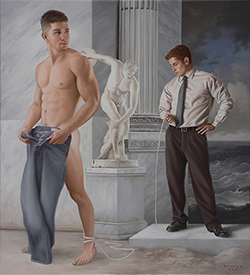
In 1962 the United States Supreme Court ruled, in the case of MANual Enterprises v. Day, that nude male photographs are not obscene. Unless Donald Trump appoints judges intent on overriding that decision, gay artist Wes Hempel is likely to safely continue referencing images of men who look like himself onto his oil painted depictions of masculinity.
In an effort to screen them from homophobic social culture, one of Hempel's predecessors, the late Tom of Finland, was effectively forced to publish his beefcake depictions of attractive, muscular young men in physical fitness and exercise magazines. Hempel turns instead… READ MORE |
|
|
Left: Wes Hempel, "Lure of Culture," 2016, oil on canvas, 22 x 20"
|
|
| Visual Art Source (VAS) is the comprehensive online resource of critical discourse and information exclusively devoted to the contemporary and fine art world of the Western and Midwestern United States. ABOUT US. |
|
presented by:

|

|
|
| | |